EU Certified Small Diggers: A Guide to Compliance
EU Certified Small Diggers: A Guide to Compliance
Blog Article
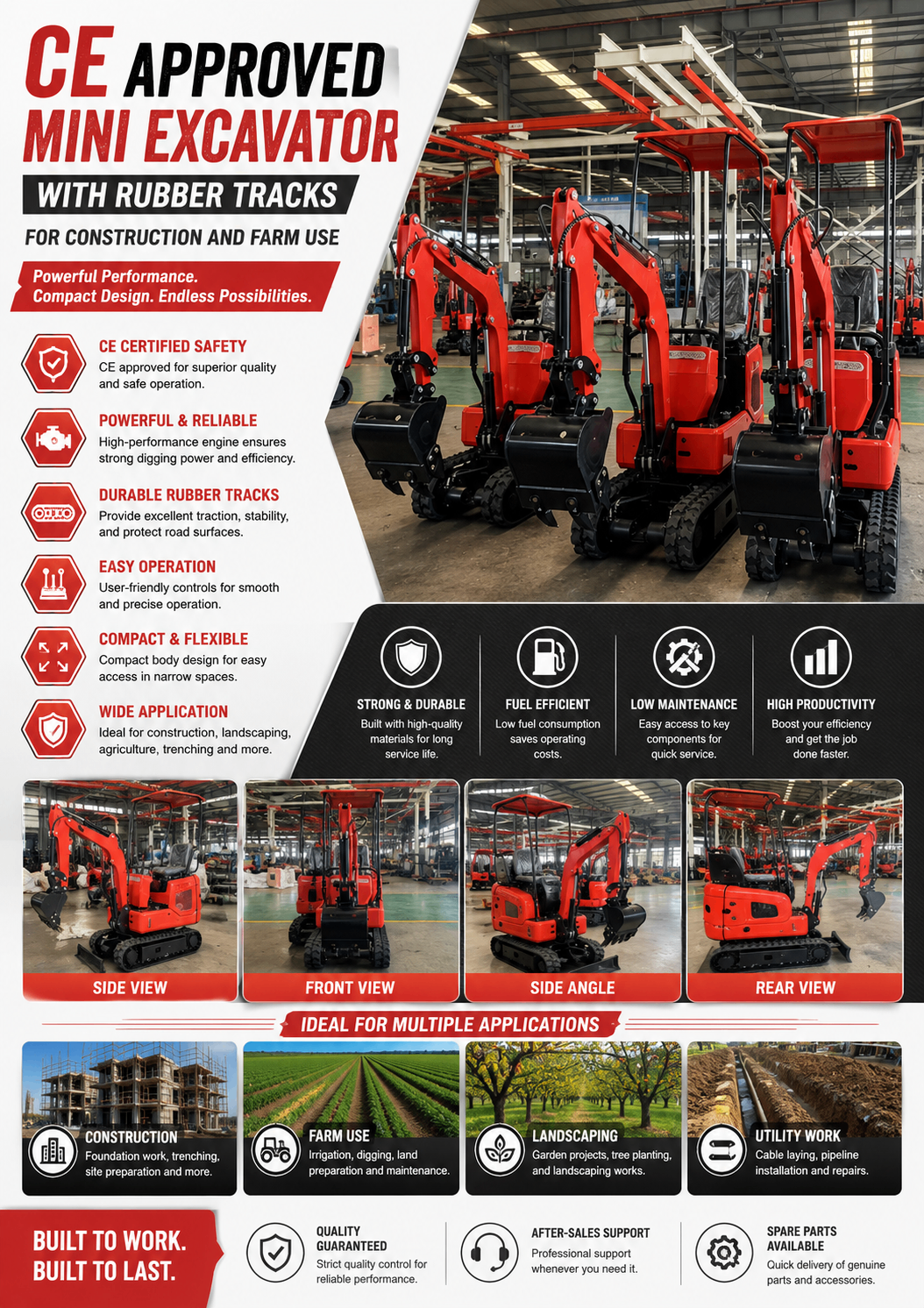
Ensuring your compact excavator meets EU certification requirements is vital for sales within European markets. These handbook details the key aspects of CE certification for small diggers, covering regulations related to operator protection, equipment evaluation, and records. Understanding the specifications enables companies to correctly deploy their vehicles and prevent possible legal action.
Steel Track Mini Machines: Outstanding Pull for Challenging Landscape
Mini machines equipped with steel tracks are changing how contractors handle projects in rough conditions. Unlike traditional tire-equipped models, these versatile machines deliver superior grip on unstable surfaces like gravel, slush, and inclined hills. This improved stability allows operators to complete projects effectively and productively, minimizing downtime and increasing performance. The flexible nature of composite tracks also diminishes ground impact, preserving delicate surfaces and minimizing site disturbance.
Mini Excavators: Significant Capability in Limited Construction Locations
These robust reduced-size excavators provide a considerable approach for tasks where conventional equipment cannot maneuver. Their limited footprint permits access to challenging areas, like underground infrastructure or between established facilities. Despite their dimensions, they feature substantial excavating force and precision, helping them ideal for a wide spectrum of construction functions. Ultimately, small excavators represent a intelligent tool for developers facing the difficulties of confined workspaces.
Mini Diggers for Properties: Flexibility and Efficiency in Crop Operations
Modern ranching operations often require machinery that can handle a scope of challenging jobs. Small machines are quickly becoming invaluable assets for producers, offering exceptional flexibility and performance across a numerous array of agricultural tasks . From excavating for irrigation networks and runoff to shifting ground for building enclosures or terraces , these machines provide a robust solution. They even excel at clearing land for seeding , grading fields , and processing materials with convenience. Their compact dimensions allows them to operate in limited spaces that larger tractors simply cannot reach .
- Digging for Irrigation
- Relocating Soil
- Preparing Land for Planting
Selecting the Best Mini Excavator regarding Site vs. Farm Uses
When considering a mini machine, it's vital to understand the significant distinctions between building projects and farm tasks . Building sites often demand greater power , accuracy , and the capacity to work in small areas . Consequently , a heavy-duty model with a wide assortment of tools might be ideal . Conversely , rural properties frequently involve less digging distances , more landscape grading , and the need for small equipment to navigate pastures . In conclusion, detailed assessment of the intended assignments is crucial for making the suitable choice .
- Consider digging distances .
- Evaluate the area constraints .
- Evaluate the required implements.
- Consider moving difficulties .
{CE Marking & Mini Diggers : What You Must to Know
Ensuring Agricultural mini excavator your {mini excavator is meets the requirements of relevant European regulations is crucial, and that's where {CE marking comes into play . This identification demonstrates that the machinery has been assessed and meets health requirements, allowing unrestricted sale within the EU. {For hirers of these machines, understanding CE certification is essential . It isn't simply about having a label on the excavator ; it represents a evaluation of construction and performance .
- Check the presence of the CE identification.
- Examine the declaration of conformity – this details the guidelines the digger meets.
- Consider that CE labeling is the supplier's responsibility – though owners must be cognizant of its significance.